
In the refugee camps of Thailand, Hmong families turned an old needlework tradition into a record of war, flight and home.




Near the center of the Migration Story banner, a gray river runs across a field of blue cloth, crowded with tiny stitched figures crossing by canoe, by raft, on inflated tubes and by swimming. Above them, planes pass over a village under attack, and below them, the people who reached the far bank are led toward houses by men in uniform. Members of the Hmong community in Victoria, Australia, made it sometime between 1985 and 1992 and sold it from their stall at a local craft market, and the story it tells, of leaving Laos, was the community's own.
Cloths like this one, known as story cloths, date only to the late 1970s, and yet they grew from one of the oldest arts in Hmong life. For centuries, Hmong women made paj ntaub, which means "flower cloth," from embroidery, appliqué, reverse appliqué and, among Hmong Leng, often called Blue or Green Hmong, indigo batik. Girls began learning the stitches as young as five, and their geometric, abstract patterns lived on the clothing that carried a family through life. They covered baby carriers and hats, which a Hmong friend told the scholar Geraldine Craig were meant to disguise children as flowers so evil spirits wouldn't pluck them away, and they covered the funeral garments a young wife sewed for her parents and in-laws to help their souls find their way after death.
To another Hmong person, those patterns spoke, marking clan, family and identity in a culture where knowledge had long passed from elder to child by voice and by hand. According to oral history in the Hmong community, recorded by the Hmong Cultural Center in St. Paul, women once hid their written script in the clothing they made, especially in the pleated skirts of Green Hmong.
The river on that banner has a history reaching back to the 1960s, when the war in Vietnam spread into Laos and the CIA formed a secret alliance with a Hmong army to fight Laotian communists and North Vietnamese troops, a conflict kept so far from public view that it became known as the Secret War. Hmong fathers and sons fought in it for more than a decade, and the mountains of Xieng Khuang province, home to many Hmong villages, became one of the most heavily bombed places on earth, where unexploded bombs were still killing people decades after the fighting ended.
When the United States withdrew in 1974, the Hmong who had fought beside it were left to face what came next, and as the Pathet Lao took power in 1975, its leaders announced plans to wipe them out, according to the Kansas Historical Society. Villages were burned and bombed, and thousands of Hmong families escaped through the jungle toward the Mekong River with only what they could carry. Because a single cry could reveal a whole family to the soldiers hunting them, many parents gave their babies opium to keep them quiet, as the Kansas Historical Society records, on a crossing where infants and adults alike lost their lives. Those who reached Thailand lived for years in camps like Ban Vinai, and there, almost overnight, something new appeared on cloth: people, animals, villages, soldiers and rivers, a pictorial language arriving, as Craig describes it, in a tradition built on abstraction.

No one can say exactly who stitched the first story cloth, but the makers themselves give the clearest picture of why it began. Ia Yang, a maker Craig knew as a friend, first saw story cloths during her year in a camp on the Thai border, though she didn't stitch her own, a scene of refugees coming to America, until she had resettled in Providence, Rhode Island. She told Craig that relief workers hadn't asked anyone to make them. The men had little to do in the camps, she said, and the cloths could bring in money for their families, but above all she believes they were made to record what had happened, which is why some carry English words, so people outside could understand the Hmong and what they had lived through.
Bee Vang-Moua, who leads the Hmong Language Program at the University of Minnesota, speaks just as plainly about the need behind them. The cloths were made to sell, she told KARE 11, so women could buy food and clothing and keep their families safe, and since they were often sold to foreigners visiting the camps, most women who made them kept none of their own. She sees them as a sign of Hmong women taking an art handed down through generations and turning it into income when their families needed it most.
Niam Song Leng Xiong, an elder in Minneapolis (Niam, the Hmong word for mother, is used as a title of respect), told KARE 11 that she and her late sister spent two months in 1981 stitching one of her cloths at Ban Vinai refugee camp in Thailand. She'd arrived there with nothing of her own, she said, and since she had once dreamed of school only to hear from her father that she didn't need it, she put everything into the sewing her mother had taught her. She still keeps her cloths today, and as she told the station, "I know the life of hardship and that's why I carry these."
She began with coasters and place mats, which sold well to a pastor's wife and to Thai government visitors who came to her because her late husband was a colonel who had fought in the Secret War, and as the work grew, she brought 20 other women into it and taught them, so that the skill her mother gave her could support their families too.
Who held the needle changed as well, according to Museums Victoria, which collected cloths from Melbourne's Hmong community and records that men began drawing scenes from traditional Hmong stories so they'd be remembered through a time of upheaval, and that women asked the men to draw them onto fabric so they could stitch them, a real shift in a culture where sewing had belonged to women.
Other accounts, many recorded by outside scholars and institutions, tell the beginning differently. Craig notes that a number of Hmong informants, along with a 1984 study from Michigan State University, credit a relief worker with suggesting that women stitch pictures to sell, while the Kansas Historical Society credits missionaries, who it says chose colors they believed would appeal to Americans, even though the Hmong themselves preferred bright, bold ones. Anthropologist Erik Cohen, whom Craig also cites, doubts both, since the relief organizations selling Hmong crafts focused on ornamental work and rarely sold story cloths at all, and he suggests the idea of drawing figures may have come from the illustrated English textbooks used in the camps.
Each account comes from a different vantage point, and none is complete on its own, yet they agree that the story cloth was born in the camps and made to sell, and the makers add the part that matters most to them, which is that it was also made to remember.
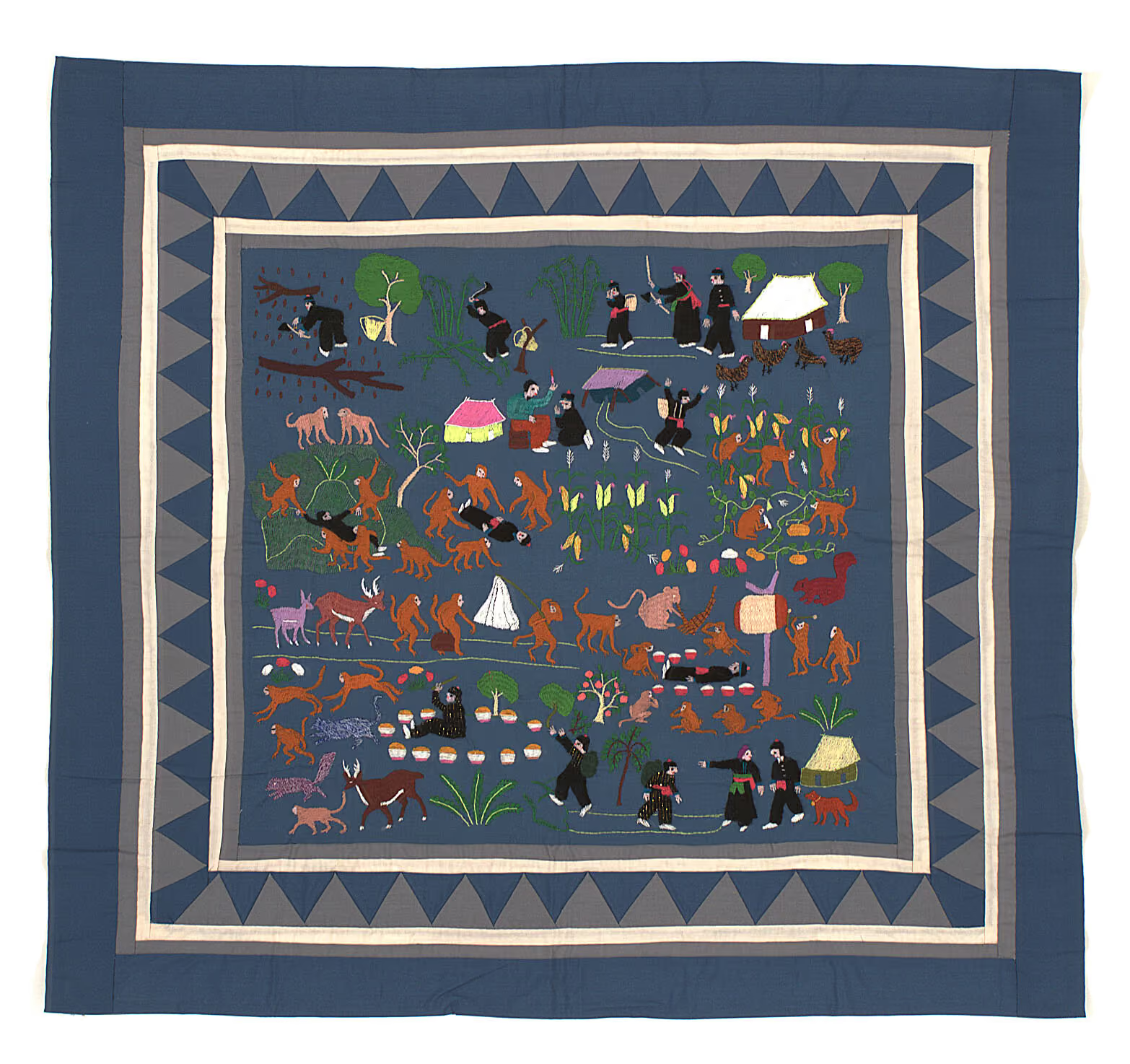
Many story cloths turn away from the war altogether, and Lee Pao Xiong, the founding director of the Center for Hmong Studies at Concordia University in St. Paul, who escaped Laos with his family in 1975, told The New York Times that most show farms, weddings and village life. The Monkey Story banner above is full of orange monkeys moving among people, deer, birds, houses and fields of corn, with a man raising a sword near the top, while the Tiger Story banner farther down shows families tending crops and carrying loads among their houses under the sun. In scenes like these, the makers held on to folk tales, harvests and celebrations like the Hmong New Year, when families reveal the new clothes they've spent months sewing, so the life they had known in the mountains of Laos could be kept and passed on.
As families left the camps for new homes, the cloths traveled with them, and in the United States, where refugees were placed largely in Minnesota, Wisconsin and California, St. Paul grew into the largest urban Hmong community of any American city, home today to more than 36,000 Hmong and Hmong Americans. Minnesota's governor, Al Quie, had visited the camps in 1979 and, as Lee Pao Xiong tells it, pressed the State Department to send the refugees to Minnesota, and one St. Paul district now carries the name Little Mekong, after the river more than 130,000 Hmong crossed to reach Thailand.
In Kansas City, Kansas, the state's folk arts program brought nine women from the Hmong community together in 1987, pairing the paj ntaub masters May Thao, May Her Thao and Shoua Xiong with younger apprentices, among them Dia Her, Phoua Her, Sae Her, Zang Her, Ah Vang and Ying Vang. The Kansas Historical Society found that the apprenticeship left all nine women making more paj ntaub than before, and freer to create their own designs than they'd been when buyers expected uniform patterns. Others made new lives as far away as Melbourne, Australia, and members of the Hmong community in Victoria, who sold their work at the Fitzroy craft market, made the three banners in this story, now held by Museums Victoria.

Fewer story cloths are made in the United States today, Vang-Moua says, since fewer women need the income they once brought, though women still make them overseas. In Laos, she says, it's illegal to sell cloths about the Secret War, so a form born to tell that story still can't tell it freely in the country where it happened.
The art is still being handed down, though, often by a generation that grew up hearing about the war only in pieces. Mai Vang Huizel founded the Hmong Museum in St. Paul in 2015 partly because she knew so little of her own parents' escape, and the museum has offered paj ntaub workshops so the stitches keep passing from one pair of hands to the next. The author Kao Kalia Yang, born in Ban Vinai, the same camp where Niam Song Leng sewed, grew up with a mother and aunt who made story cloths there, and she calls what Hmong women did with them "a rebellious act," a way of keeping their stories for the generations to come with whatever they had. In Wisconsin, the maker Mao Lor credits her mother with teaching her how to sew and how to live, the same gift Niam Song Leng received, and her story cloths have influenced younger Hmong artists such as Ger Xiong.
In 2025, fifty years after the Hmong began resettling in the United States, the La Crosse County Historical Society in Wisconsin built an exhibit of story cloths with Hmong historian Yia Vue and UW-La Crosse professor Vincent Her, so Hmong people could tell the cloths' stories in their own words. "The Secret War is part of American history," Vue said, and these cloths are among its most personal records. Niam Song Leng hopes for something just as lasting, telling KARE 11 that when she's gone, she wants people to know a Hmong woman found something within herself to create during the hardest years of her life, and every story cloth, from the river on that blue banner to the scenes still being stitched in St. Paul, keeps that truth for anyone willing to look.
Hero image: detail of the Hmong Migration Story banner shown above. Courtesy of Museums Victoria.
For the readers who stay after the last line.