
How a printmaker's street broadside became one of the most beloved images of Día de los Muertos.





Every autumn, as marigolds fill the markets and families across Mexico prepare their ofrendas for Día de los Muertos on November 1 and 2, a skeleton woman in a wide hat heaped with flowers and feathers appears almost everywhere, on altars and parade floats, in shop windows and on painted faces, wearing a smile that was first drawn for the street. She began on a sheet of thin, brightly colored tissue paper sold for very little money on the streets of Mexico City, one of countless prints whose skeletons sold fish, rode the new electric trolleys, danced, quarreled, and dressed up for an evening out, while the rhyming verses beneath them took sly jabs at the living.
Those prints were called calaveras, after the Spanish word for skulls, and the man behind most of their pictures was José Guadalupe Posada, a working printmaker whose quick, sure hand on a metal plate helped feed a whole city's appetite for news, gossip, and laughter. His story begins far from the capital, in the city of Aguascalientes, in the high plains at the center of Mexico.
Posada was born there on February 2, 1852, one of eight children, and it was his older brother Cirilo who first taught him to read, write, and draw. After classes at the city's Municipal Drawing Academy, he apprenticed in 1868 with José Trinidad Pedroza, a printer who taught him lithography and engraving, and by 1871 the young artist was drawing political cartoons for a local paper called El Jicote, which closed after only eleven issues, reportedly because one of his cartoons offended a powerful local politician, an early sign of the sharp eye he would turn on the powerful for the rest of his life.
For the next sixteen years he lived in León, Guanajuato, where he worked alongside Pedroza in commercial printing, opened a workshop of his own, taught lithography, and married María de Jesús Vela. That steady life changed after the great flood of June 1888, which swept through León and which Posada recorded in his prints, and before the year was out he had moved to Mexico City, a growing capital crowded with newspapers, presses, and readers.
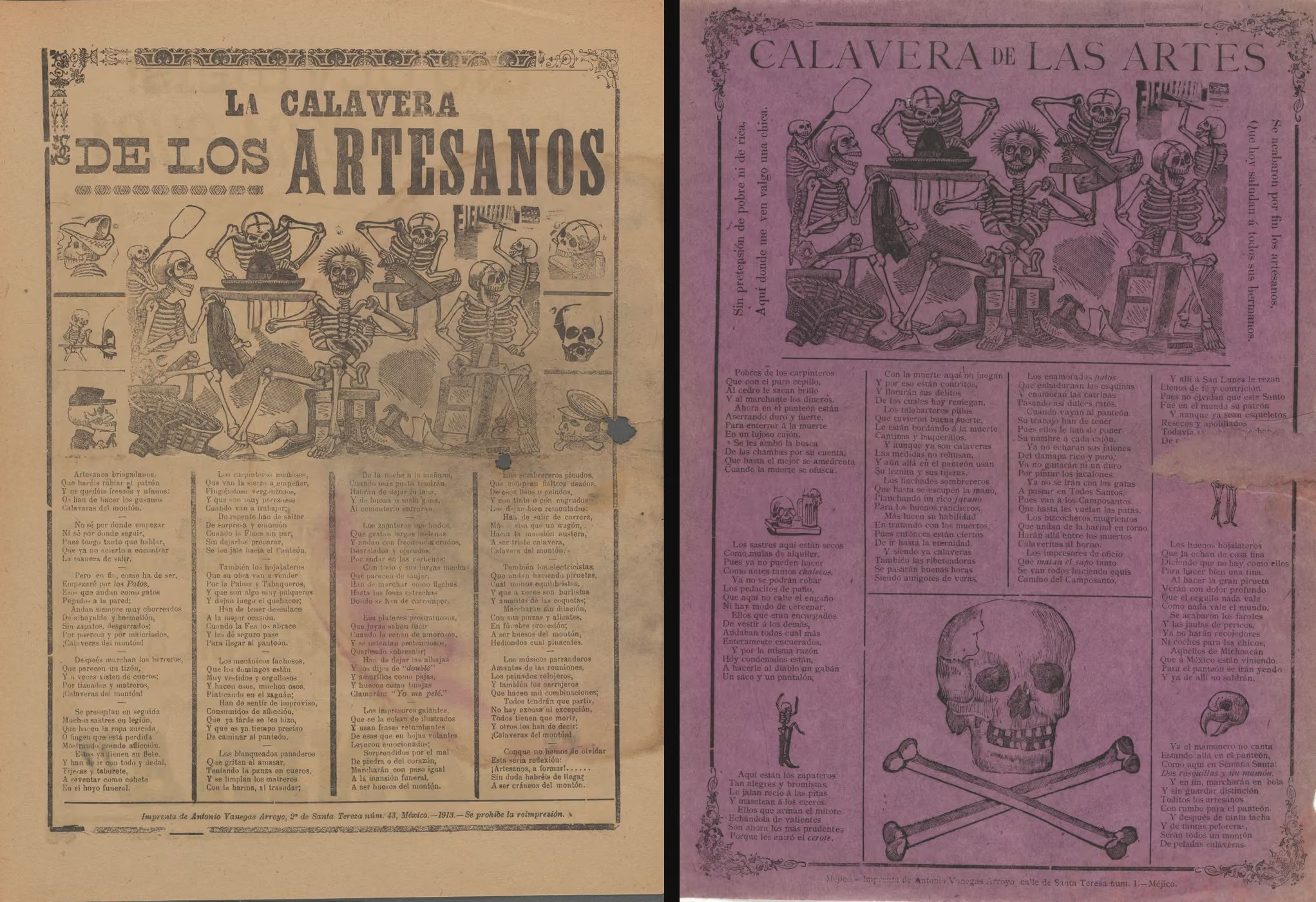
In the capital, after a stint drawing for the magazine La Patria Ilustrada, Posada began working with Antonio Vanegas Arroyo, a publisher whose press turned out cheap reading for working people, including chapbooks, song sheets, book covers, and broadsides of every kind, sold in shops and street stalls across Mexico. Scholars estimate that Posada made more than 20,000 images over his career, many of them for Vanegas Arroyo, and to keep up with that pace he relied on photo relief etching, a process that gave his drawings the bold look of a woodcut in about half the time, on metal plates that could be printed again and again.
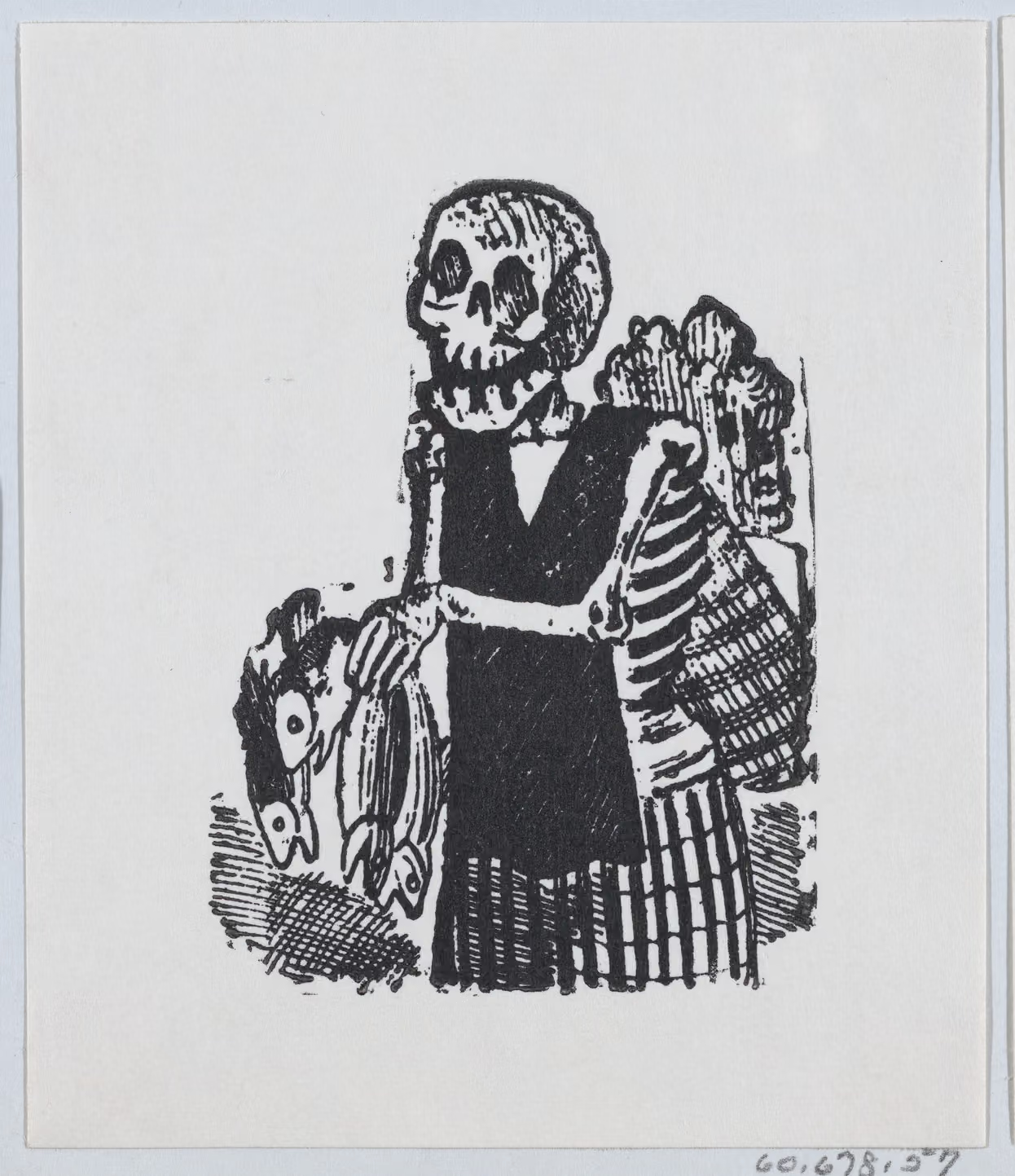
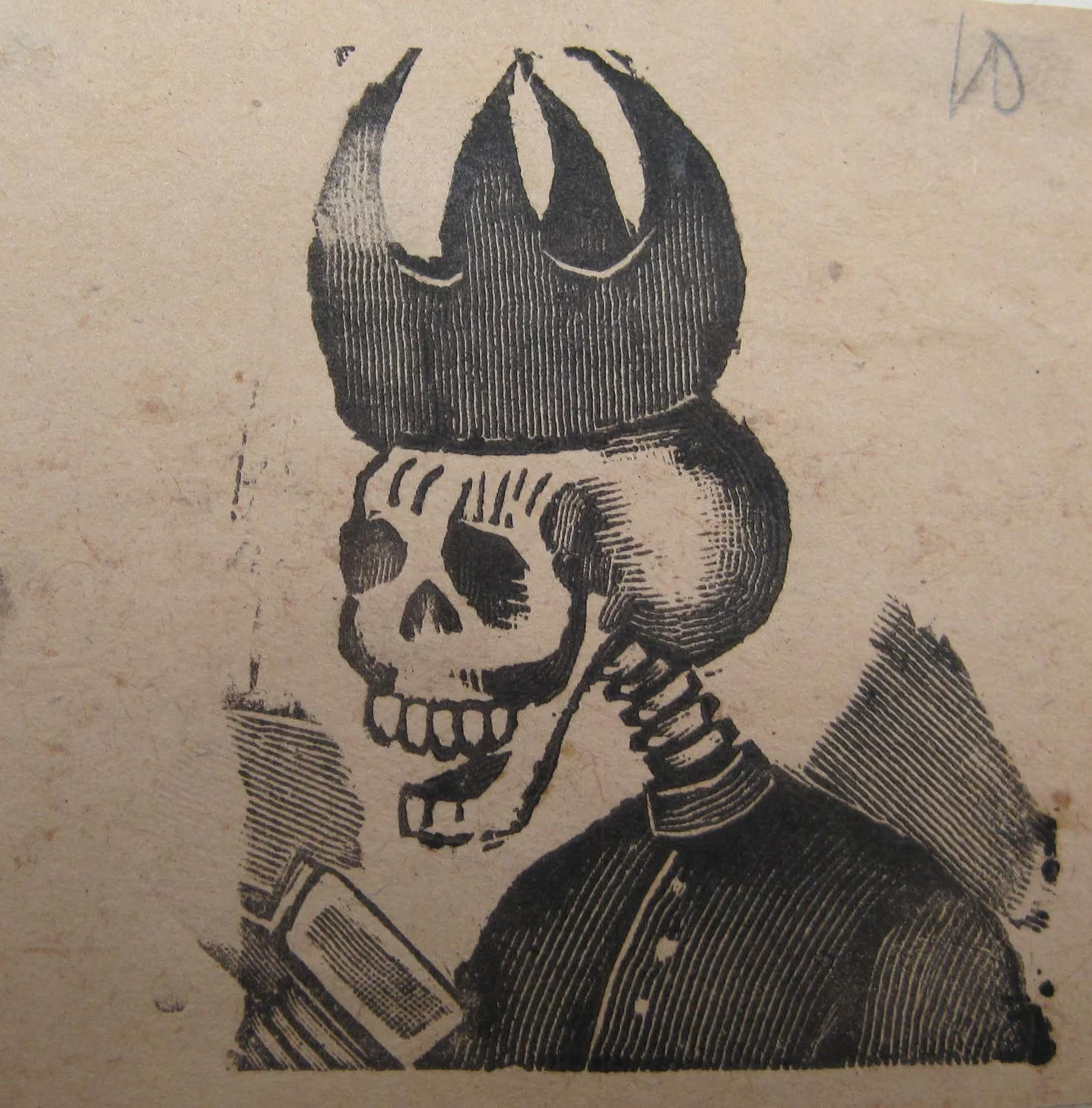
Skeletons were already a familiar sight on the broadsides families bought for their visits to the cemetery on the Day of the Dead, and Posada and Vanegas Arroyo turned that old custom into something sharper. In their calaveras everyone ended up as bones, which meant everyone could be laughed at, the politician and the priest as easily as the bullfighter, the fashionable lady, the waitress, and the street vendor, and the verses beneath the pictures, written by others at the press, often took the form of mock epitaphs for people who were still very much alive. Under the long rule of Porfirio Díaz, when open criticism could carry real risk, a grinning skeleton made a useful disguise, and the calaveras poked fun at the middle class, the wealthy, and the government alike. They also caught the feel of a city in motion, with skeletons riding the new trolleys, journalists on bicycles trampling rival papers, and cholera striking rich and poor without favor, which may be the oldest point the calaveras ever made, that death treats every one of us the same.
Sometime around 1910 to 1912, as the Mexican Revolution was beginning, Posada etched the image that would outlive everything else he made, a bare skull grinning beneath an enormous hat crowned with flowers and plumes. She first appeared in print in 1913 on a broadside about garbanceras, a word for the women who sold garbanzo beans in the markets, and what she was meant to mock is still debated. One reading holds that Posada drew her to tease the fashionable ladies of the Porfirian elite, who copied European styles while looking down on anything homegrown, while another points to the verse, which Posada didn't write, as aimed at working women who powdered their faces and wore French fashions to seem upper class. Either way, the satire pointed to the same truth, that a fine hat can't hide who we are, since underneath, as the calaveras liked to remind everyone, we're all the same bones.
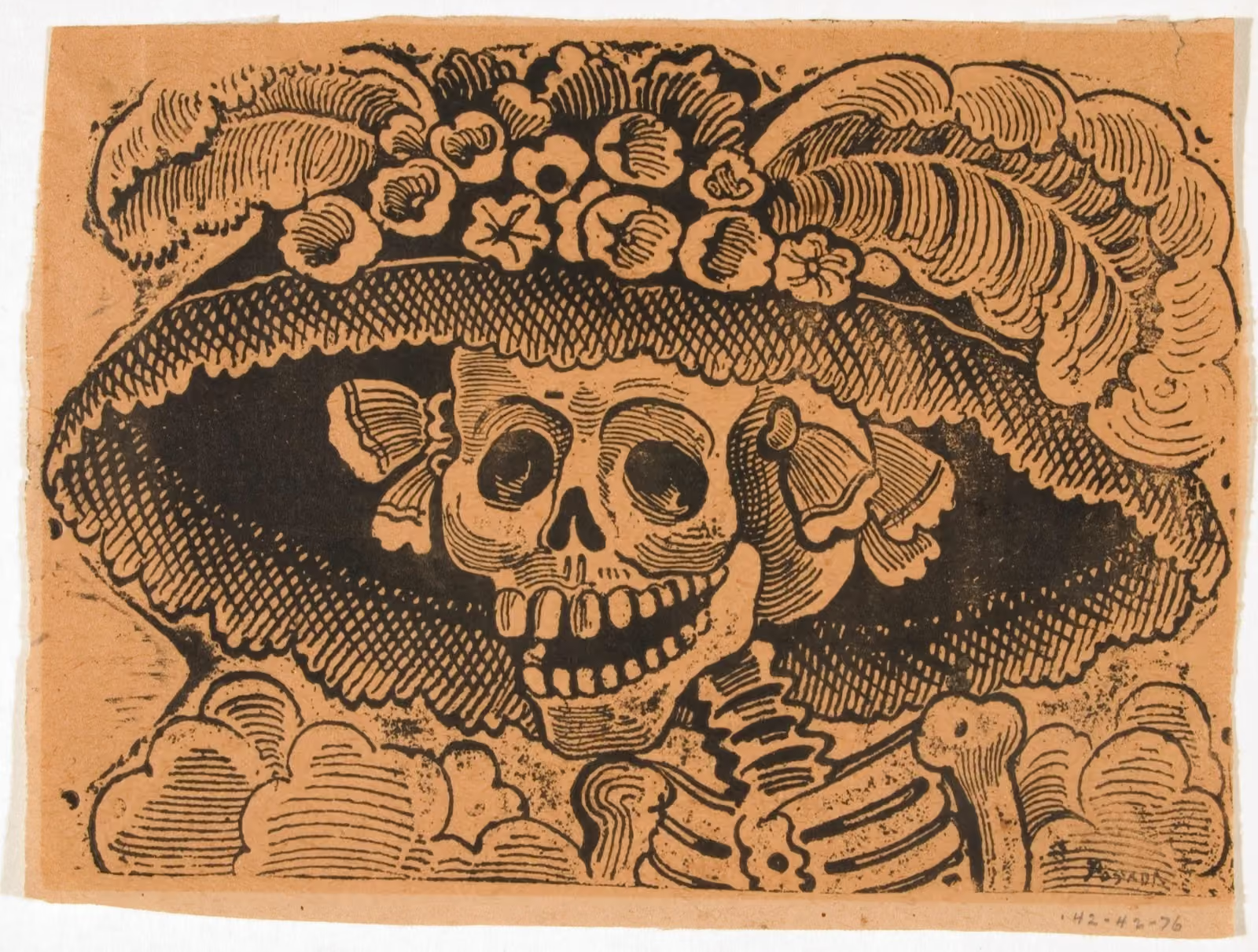
Posada never saw her in print, because he died in Mexico City on January 20, 1913, a few years into the Revolution, poor and largely forgotten, and was buried in an unmarked pauper's grave. When three neighbors came forward to certify his death, only one of them knew his full name.
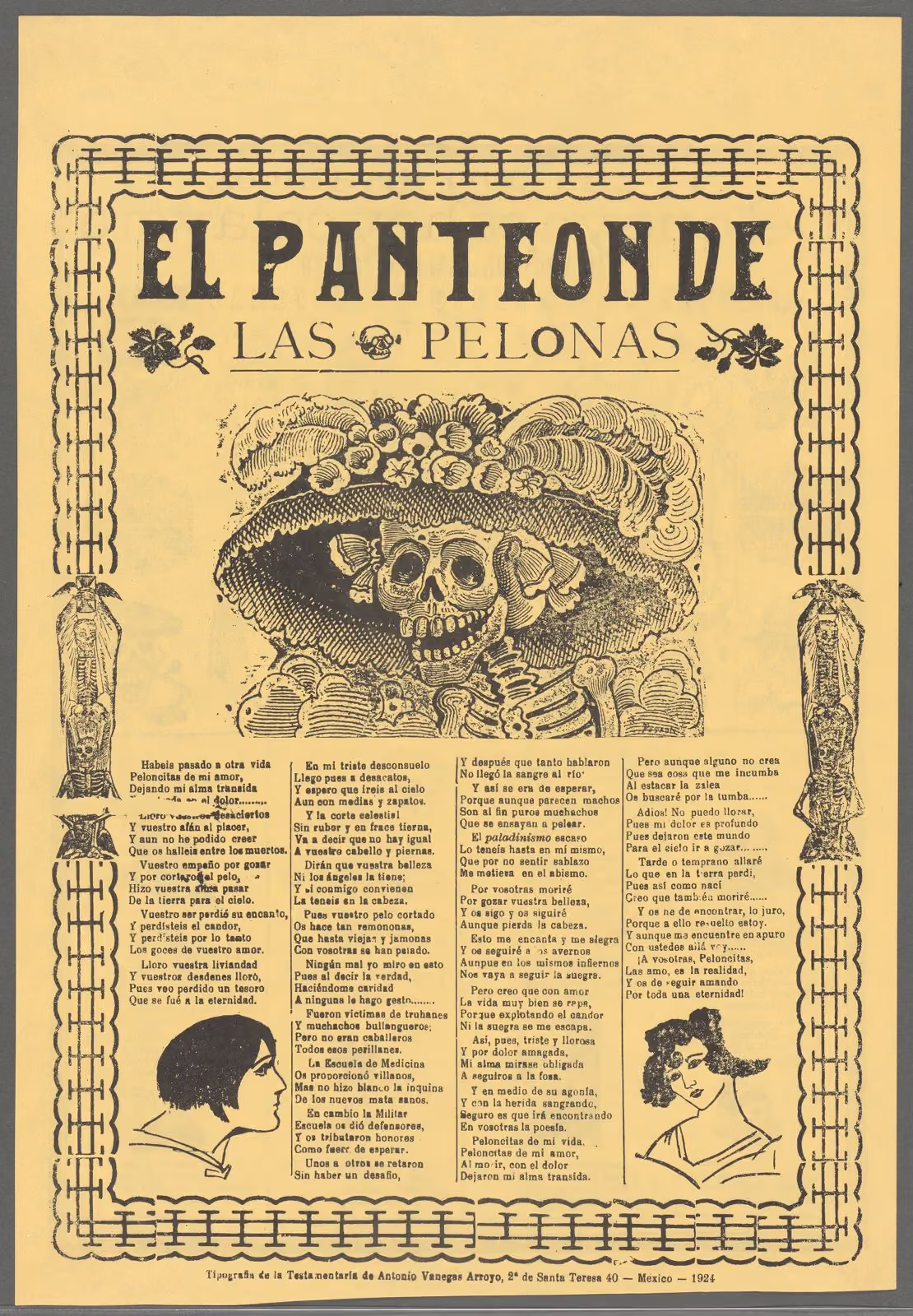
His pictures kept circulating all the same, since the Vanegas Arroyo press went on printing from his plates for years, and most of the people who bought the calaveras had no idea who had made them. It was a French-born artist living in Mexico, Jean Charlot, who noticed the same strong hand running through those inexpensive prints, traced it back to the Vanegas Arroyo press, and in 1925 published the first known article about Posada, presenting him as a forerunner of Mexico's modern art movement. Others followed, among them the writers Anita Brenner and Frances Toor, and in 1930 Toor published the first book of his work, made with the publisher's son, Blas Vanegas Arroyo, and the artist Pablo O'Higgins, with an introduction by Diego Rivera. It was in that book that the skeleton woman in the flowered hat was first called La Calavera Catrina, from catrín, a word for a well-dressed dandy.
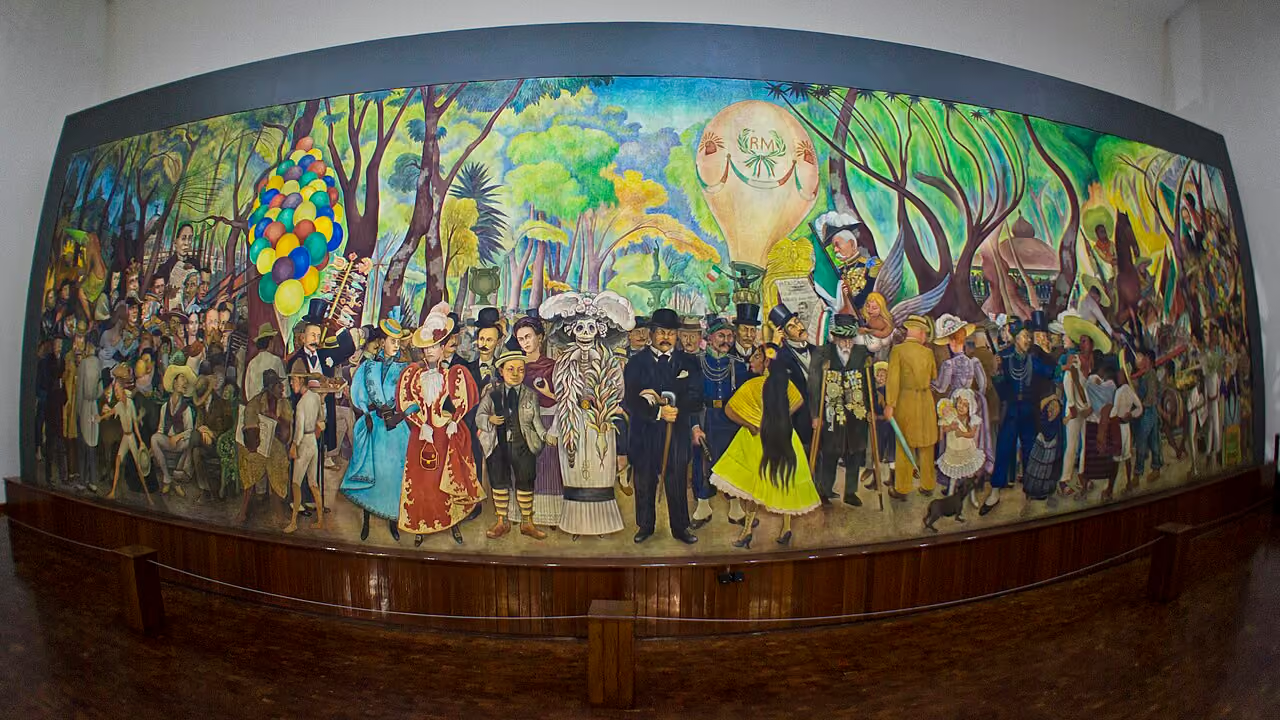
Rivera did more than anyone to make her famous, though he also reshaped Posada's story to suit his own ideals, presenting him as a revolutionary artist in ways that historians now treat with caution. In his great mural Dream of a Sunday Afternoon in the Alameda Central, painted in 1946 and 1947, Rivera gave La Catrina a full body for the first time, dressed her in a long skirt and a feathered boa, and placed her at the very center, with Posada standing beside her in a bowler hat and Rivera himself, painted as a boy, holding her hand. In that single image, the printmaker who died without a headstone stands at the heart of Mexican history, and the skeleton he drew for the street becomes a national symbol.
Since then she has traveled far from the tissue-paper sheets where she began, appearing on ofrendas and in parades, on sugar skulls and in museum galleries, and more and more on costumes and products that have little to do with the tradition she came from. That's worth keeping in mind as November approaches, because Día de los Muertos is a living practice, a time when families welcome back the people they have lost, and the calavera belongs to that welcome. The calaveras literarias live on as well, as people across Mexico still write playful rhyming epitaphs each year for friends, teachers, and public figures, carrying forward the same affectionate teasing that filled Vanegas Arroyo's sheets. The press itself passed from Antonio to his son Blas and then to Blas's son Arsacio, and the family still looks after its legacy, and Posada's, today.
Posada spent his life making pictures for people who would never hang them on a wall, and more than a century later his skeletons are still riding, dancing, and dressing up for all of us. The next time La Catrina smiles at you from beneath her flowered hat, it's worth remembering the printmaker who gave her that smile, and the crowded street where she first went out into the world.
Posada's prints are held in collections across Mexico and the United States, and many of them can be viewed online for free. In Aguascalientes, the city of his birth, the Museo José Guadalupe Posada is devoted to his work, and in Mexico City, Rivera's Dream of a Sunday Afternoon in the Alameda Central, with La Catrina at its center, hangs in the Museo Mural Diego Rivera. In the United States, the Metropolitan Museum of Art, the New York Public Library, the Library of Congress, the Philadelphia Museum of Art, the Brooklyn Museum, the Baltimore Museum of Art, and the Art Institute of Chicago all hold his calaveras. Gallery displays change, so check each museum's website to see what's on view before you visit.
Who was José Guadalupe Posada? José Guadalupe Posada (1852 to 1913) was a Mexican printmaker and illustrator, best known for the calavera broadsides he made for the Mexico City publisher Antonio Vanegas Arroyo and for the image that became La Catrina.
Who created La Catrina? Posada etched the image around 1910 to 1912, and it was first published in 1913, after his death. It was named La Calavera Catrina in a 1930 book of his work, and Diego Rivera made her a national symbol in his 1946 to 1947 mural Dream of a Sunday Afternoon in the Alameda Central.
What does Catrina mean? The name comes from catrín, a Spanish word for a well-dressed dandy. The image first appeared on a broadside about garbanceras, women who sold garbanzo beans, and historians still debate whether its satire was aimed at the elite or at working women dressing above their station.
What is a calavera? Calavera is Spanish for skull. In Posada's time, calaveras were inexpensive illustrated broadsides that showed people as skeletons alongside humorous verse, often written as mock epitaphs. Today, calaveras literarias, playful rhyming epitaphs for the living, are still written each year for Día de los Muertos.
When is Día de los Muertos? Día de los Muertos is celebrated on November 1 and 2, when families honor and welcome back loved ones who have died, often with ofrendas, or home altars, and visits to the cemetery.
Hero image (credit line for the bottom of the post body): José Guadalupe Posada, Calavera Catrina (Calavera of the Female Dandy), 1913. Philadelphia Museum of Art.
José Guadalupe Posada, a skeleton selling fish, from the broadside Una Calavera Chusca, about 1880 to 1910 (later impression), zincograph. The Metropolitan Museum of Art, Gift of Roberto Berdecio, 1960 (60.678.57). Public domain.
José Guadalupe Posada, Calavera "Clerical", relief engraving. Brooklyn Museum, Gift of Wilfred P. Cohen. No known copyright restrictions.
José Guadalupe Posada, Calavera Catrina (Calavera of the Female Dandy), 1913, the full print (same object as the hero). Philadelphia Museum of Art.
José Guadalupe Posada, El Panteón de las Pelonas, issued 1924. Printed by Antonio Vanegas Arroyo. From The New York Public Library.
José Guadalupe Posada, La Calavera de los Artesanos, 1913. Printed by Antonio Vanegas Arroyo. From The New York Public Library.
José Guadalupe Posada, Calavera de las Artes, catalogued by the museum as Skeletons as Artisans, about 1910, metal relief print. Published by Antonio Vanegas Arroyo. The Baltimore Museum of Art, Gift of a MAD Gathering (2017.382). Public domain.
Diego Rivera, Dream of a Sunday Afternoon in the Alameda Central, 1946 to 1947. Museo Mural Diego Rivera, Mexico City. Photo by Wikipologus, June 20, 2015, licensed under CC BY-SA 4.0, no changes. Mural © Banco de México Diego Rivera Frida Kahlo Museums Trust, Mexico City / Artists Rights Society (ARS), New York. Used for commentary.
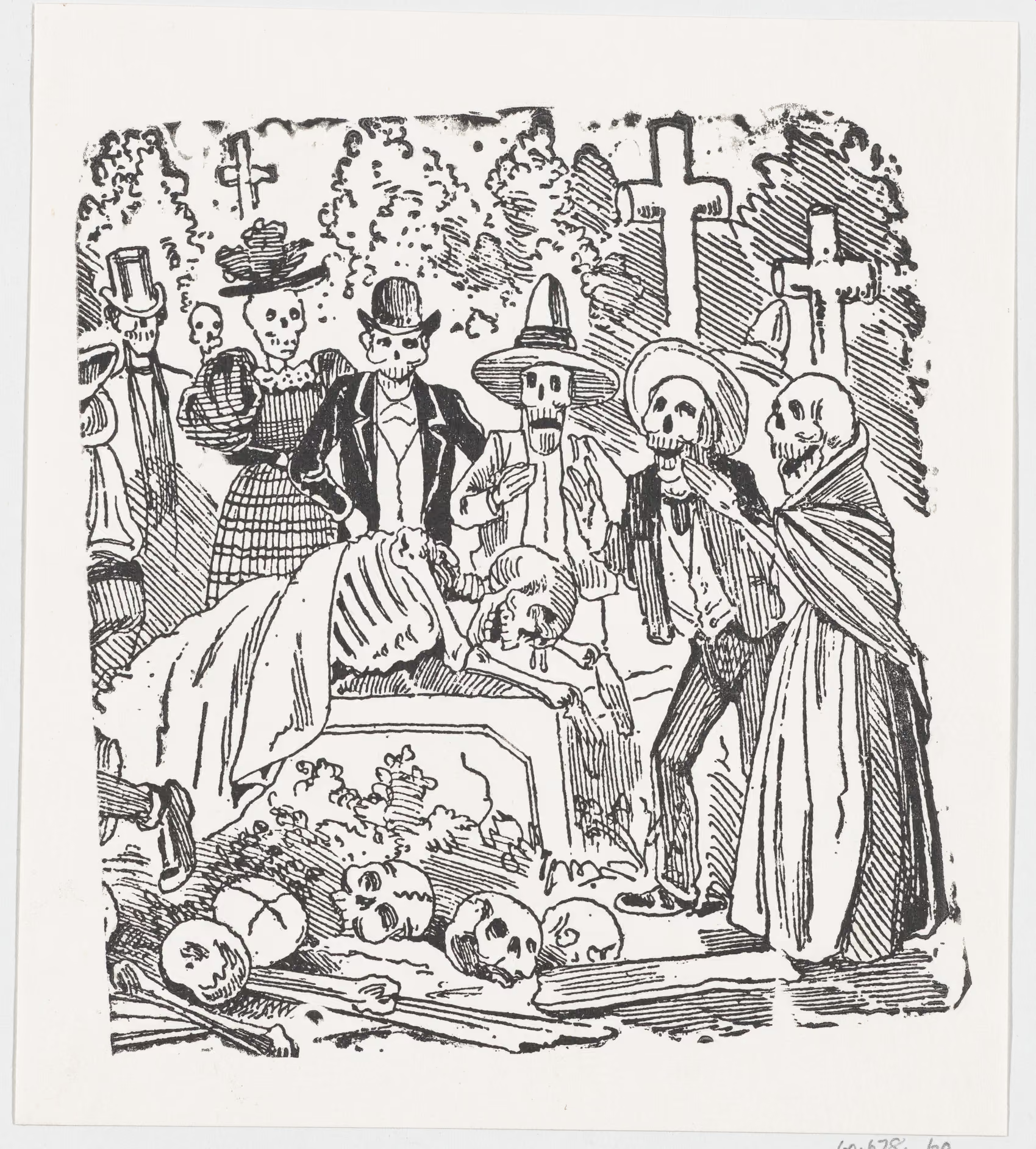
José Guadalupe Posada, a skeleton covered with a sheet crying in a cemetery, from the broadside Calavera llorando el hueso, about 1880 to 1910 (later impression), zincograph. The Metropolitan Museum of Art, Gift of Roberto Berdecio, 1960 (60.678.60). Public domain.