
In the early 1900s, Ho-Chunk artist Angel De Cora illustrated books by Native authors and taught Native students to trust the designs their own nations had kept for generations.





Open a first edition of Natalie Curtis's The Indians' Book, published in 1907, and before a single song or story begins you'll meet lettering drawn by hand in a design language rooted in Native tradition. The artist behind it was Angel De Cora, a Ho-Chunk painter, illustrator, and teacher who spent her working life making one point as clearly as she could, through her pictures, her books, and her classroom: Native artistic traditions were specific, alive, and deserving of the nation's respect.
She was born on the Winnebago Reservation in Nebraska, most likely on May 3, 1871, though some sources place her birth as early as 1869. Her Ho-Chunk name is written Hinųk Mą̄xiwi Kerenąka in the Ho-Chunk writing system used today, and in her lifetime it was printed as Hinook-Mahiwi-Kilinaka, and its translations differ, from "Fleecy Cloud Floating in Place" to "Woman Returning Back to the Sky." Her grandfather was Little Decorah, a hereditary chief, and as his granddaughter and a member of the Thunderbird clan, she was raised with the expectation that she would carry Ho-Chunk ways forward. Her English name, as the story is told, came when a relative opened a Bible and the word "angel" caught her eye.

In 1883, when she was about twelve, a white man offered her and six other children a ride on a "steam car," and that ride ended at the Hampton Normal and Agricultural Institute in Virginia, more than a thousand miles from home, without her family's knowledge or consent. Hampton had been founded to educate formerly enslaved Black students and had begun admitting Native students a few years earlier, and like the boarding schools that followed its model, it was built to remake the children it took in. When De Cora was finally allowed home three years later, her mother told her she had wept and mourned for her for months. She later returned to Hampton and graduated in 1891, and from there she followed art wherever it would take her.
Art took her a remarkable distance, first to the Burnham school in Northampton, Massachusetts, and then to Smith College, where she studied in the art department under the painter Dwight William Tryon, whose quiet, atmospheric Tonalism stayed in her work for years, and graduated in 1896. At the Drexel Institute in Philadelphia, she earned a place in Howard Pyle's illustration classes, and Pyle, the most influential American illustrator of his day, said she had "not only talent but genius" and encouraged her to spend time at the Fort Berthold Reservation in North Dakota, drawing from life. She went on to study at the Cowles Art School in Boston with Joseph DeCamp, who sent her to the School of the Museum of Fine Arts, where she spent about two years under Frank Benson and Edmund Tarbell. By the end of the 1890s, she had trained with some of the most respected painters in the country, something very few women of any background could claim.

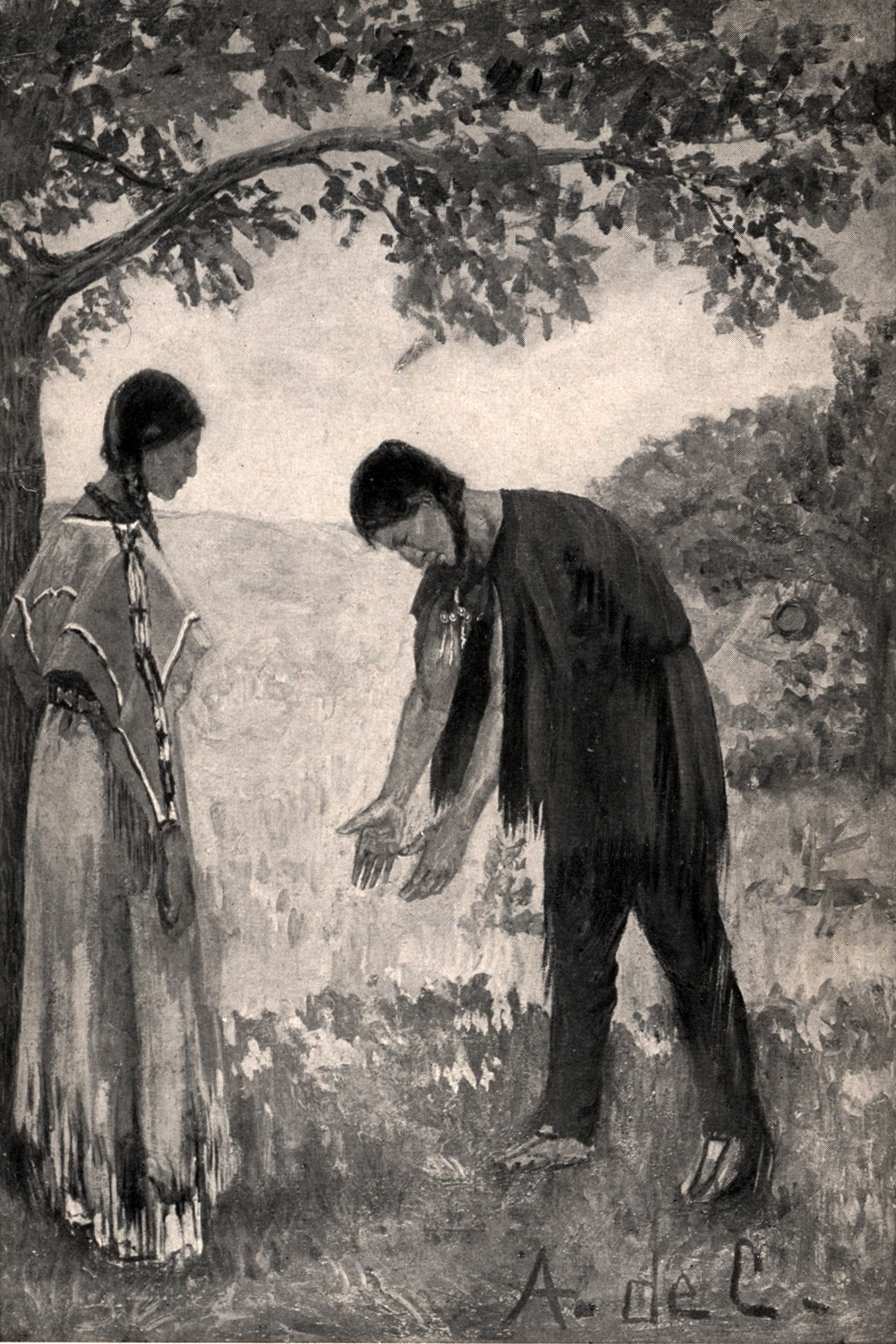
In 1899, Harper's Monthly published two of her semi-autobiographical stories, "The Sick Child" and "Gray Wolf's Daughter," which she wrote and illustrated herself. Her pictures showed Native people as her contemporaries, in the clothing they actually wore, at a time when most images of Native life were drawn by outsiders who leaned on generic symbols of the West, and De Cora took the opposite care, using design elements tied to particular nations so that Native readers who knew those designs would see that she had gotten them right.

That care shaped her book work, which is where much of her art survives today. She illustrated The Middle Five (1900), Francis La Flesche's memoir of Omaha boys at a mission school, and in 1901 she designed the binding and frontispiece for Old Indian Legends, the Dakota stories retold by Zitkála-Šá. Her drawings appeared in Wigwam Stories and, later, in Yellow Star (1911). For The Indians' Book, Curtis's large collection of Native songs and stories, she drew the title page and the lettering that introduced its sections. Again and again, when Native authors put their words into print, De Cora's hand was there to meet them on the page.

In 1906, Francis Leupp, the Commissioner of Indian Affairs, recruited her to teach art at the Carlisle Indian Industrial School in Pennsylvania. Carlisle was the flagship of the federal boarding school system, and its founder, Richard Henry Pratt, had summed up its purpose in 1892 with the words "Kill the Indian in him, and save the man." Leupp had begun to allow some Native art into the schools, and De Cora agreed to come on one condition, that she "shall not be expected to teach in the white man's way." For nine years she asked her students to look back toward their own nations, to research the designs their families had kept, and to treat that inheritance as the foundation of their work. In her first summer she asked to learn Persian rug weaving so she could teach it, and she proposed that students be allowed to copyright their own designs and earn from them. Her department designed a frieze for the walls of Carlisle's exhibit at the 1907 Jamestown Exposition. The contradiction was real, and she lived inside it every day, teaching pride in Native design within an institution built to erase Native identity.

During those years, she married William "Lone Star" Dietz, an artist and football player she had met at the 1904 St. Louis World's Fair, and the two collaborated on illustrations before divorcing in 1918. She also became one of the clearest public voices for Native art. She spoke at the Lake Mohonk Conference, served as an officer of the Society of American Indians, and illustrated its quarterly journal. When she spoke in public, she often wore Plains-style regalia, presenting herself as a modern Native woman to audiences who preferred to imagine Native people in the past. In a 1911 essay in Carlisle's Red Man, she wrote that "the Indian's artistic conception is well worth recognition," and she argued that Native art belonged within any honest definition of American art. Natalie Curtis, who knew her well, later recorded her saying, "My people are a race of designers. I look for the day when the Indian shall make beautiful things for all the world."
De Cora left Carlisle in 1915 and kept illustrating, much of it for the Society of American Indians. In the winter of 1919, during the influenza pandemic, she fell ill while staying with a friend in Northampton, and she died of influenza and pneumonia on February 6, 1919, in her late forties. In her will, she left $3,000 to the Society of American Indians, a final gift to the cause she had served her whole adult life.
Part of the reason her name faded is that so little of her painting survives, and her finest work lived in books, where illustrators were rarely given lasting credit. Part of it came from the critics who followed her, because although she was called "the first real Indian artist" in her lifetime, decades later some writers judged her work too Western in its training to count as authentic Native art, a verdict that asked her to be only one thing when she had spent her career proving she could be both. Slowly, though, she has been coming back into view, and her work appeared in Hearts of Our People: Native Women Artists, the landmark exhibition organized by the Minneapolis Institute of Art in 2019, and the Delaware Art Museum's library has published an online exhibition of her book designs drawn from the papers of Pyle's circle. On her home reservation, the Winnebago Tribe of Nebraska keeps her name on the Angel De Cora Museum and Research Center.

The next time you hold an old book from the early 1900s, it's worth turning to the title page before you begin, because the artist who drew it may have known the stories inside as their own. De Cora's lettering is still there, waiting at the front of The Indians' Book, along with the conviction that guided her, that her people's designs could stand anywhere with dignity. If you're near Wilmington or Winnebago, or simply near a library with a good special collection, her work is waiting for a closer look.
Hero image: Angel De Cora, Untitled (interior scene), 1903. Oil on linen. Museum of Nebraska Art, Museum Purchase made possible by Cliff Art Endowment.
Who was Angel De Cora? Angel De Cora (Hinųk Mą̄xiwi Kerenąka, about 1869 to 1919) was a Ho-Chunk painter, illustrator, designer, and teacher from the Winnebago Reservation in Nebraska. She studied at Smith College and with Howard Pyle, and she became one of the best-known Native artists of her time.
What books did Angel De Cora illustrate? Her book work includes The Middle Five (1900) by Francis La Flesche, Old Indian Legends (1901) by Zitkála-Šá, Wigwam Stories (1901), The Indians' Book (1907) by Natalie Curtis, and Yellow Star (1911) by Elaine Goodale Eastman.
What did Angel De Cora teach at Carlisle? From 1906 to 1915, she led Native art instruction at the Carlisle Indian Industrial School. She encouraged students to research and use the designs of their own nations, and she pushed for them to own the rights to their designs.
Why is Angel De Cora less known today? Few of her paintings survive, and much of her finest work was book design, where illustrators were rarely credited for long. Museums and Native scholars have been bringing her work back into view since the 2019 exhibition Hearts of Our People.