Drumming Up Healing
8 min read
Ava Rose

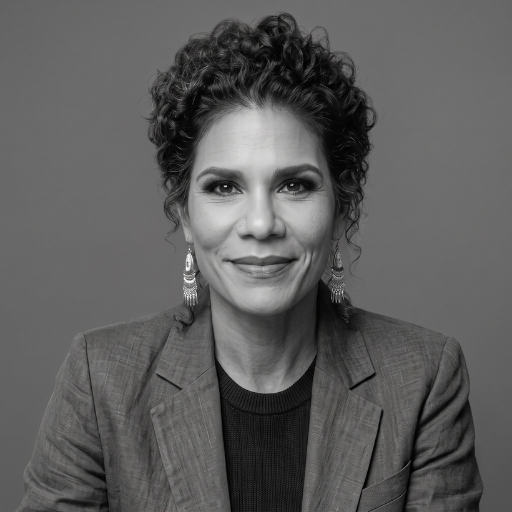




Early in the morning, before the rest of the house was awake, a young Joe Feddersen would walk down a long hallway. At the end of it, he'd find his mother at the dining table, drawing. She had a short stretch of quiet between her husband leaving for work and her six children getting up, and she spent it making art. Most often she drew horses.
That memory has stayed with Feddersen all his life. Now in his seventies, he shared it with Cascade PBS in 2025, and you can feel it in nearly everything he's made since: home, family, the animals of the land, and quiet time set aside for making.
Today he makes baskets in the Plateau tradition of his mother's people. One of them carries a design that looks as though it could be centuries old, a vertical line crossed by short horizontal ones. Then you learn that it's called Parking Lot.
That small surprise is where his art has lived for more than forty years. Feddersen has drawn on the patterns, stories, and landscape of the Colville Reservation in Washington State, and set beside them the marks of modern life: highways, cul-de-sacs, high-voltage towers. The result is a visual language that belongs to him, and to the community he calls home.
That story begins in Omak, a small town near the Canadian border where half the streets sit on the Colville Reservation. Feddersen was born there in 1953. His father, of German heritage, worked at a lumber mill. His mother was Okanagan and Arrow Lakes, raised on the Penticton Reserve in British Columbia. Neither of them grew up with English. His father's first language was German, and his mother's was Okanagan.
He describes himself simply as Native, of Okanagan and Arrow Lakes lineage, and he's a citizen of the Confederated Tribes of the Colville Reservation.
Summers belonged to Penticton, where his grandparents lived. On those long visits, the kids had the days to themselves. They swam in one lake, walked across town to swim in the other, and climbed the hills behind the house until evening called them in.
Art ran quietly through the family, mostly through people's hands. His grandmother worked hides and made gloves, an uncle who died young carved, and his mother had her horses. In high school, Feddersen took a job at a ceramics shop in Omak, and before long the teenager was teaching customers how to paint their own pieces. It was his first taste of both making and teaching.
A paperwork mix-up kept Feddersen from starting at the University of Washington after high school, so he enrolled at Wenatchee Valley College instead, and it turned out to be the right place. He found a close community there, including Anita Cheer, an elder from Omak who guided Native students, and art teacher Robert Graves, who became a mentor and a lifelong friend.
After a year, his mother's best friend, a woman he thought of as an aunt, told him about an opening at the local Public Utility District. It was the kind of job people in the region simply didn't turn down. He took it, finished his associate degree at night, and earned journeyman cards as both a hydromechanic and a hydro operator. By 26, he was second in command at a hydroelectric dam, watching the dials that kept the power flowing.
Then, with encouragement from his coworkers and from Graves, he cashed in his retirement and entered the University of Washington's art program in 1979. It was a brave leap, and his family stood behind it. His mother had always told him to follow his dreams.
Still, the dam stayed with him, and so did the ridges above Omak, which were bare when he was young. Now high-voltage lines march across them, and those towers appear again and again in his prints, glass, and baskets. "I think of the high voltage towers as thieves," he said in a segment for PBS's Art by Northwest, describing lines that carry his people's resources away. It's a striking image from a man who once kept those generators running.
At the University of Washington, Feddersen met the first of many teachers who would shape his work. He's joked that he seems to collect them, and that they tend to become extended family. There, he became studio aide to printmaker Glen Alps, who talked less about technique than about philosophy and the freedom to choose your own direction. In his 2021 oral history for the Smithsonian's Archives of American Art, Feddersen recalled that Alps once spent an entire class session on breathing naturally, arguing that art should come the same way. He took it to heart, and he still aims for work that feels like a natural extension of himself.
Another professor, painter Michael Spafford, asked students to pick a single subject and stay with it for ten weeks. Feddersen chose rain, and his classmates wondered what he could possibly do with it for that long. The answer became his Rainscape prints and his first shows in Seattle.
The mentor who reached deepest was Vi Hilbert, the Upper Skagit elder who devoted her life to keeping the Lushootseed language alive. She brought her students to Smokehouse ceremonies and welcomed them into her community. She loved it when he put Native stories into his art, and she once told him that at heart he was a storyteller. He's said the narrative is what holds all his work together.
In 1982, at a Native art conference in Seattle, he sat at a long restaurant table and met Jaune Quick-to-See Smith, Truman Lowe, and George Longfish. Smith became a close friend and mentor, and the two caught cheap red-eye flights to New York to visit bookstores and see shows together, and she introduced him to galleries. Lowe, a Ho-Chunk sculptor, invited him to the University of Wisconsin, where Feddersen earned his MFA in 1989 and first worked with glass.
In 1989, Feddersen began twenty years of teaching at The Evergreen State College in Olympia. It was there that his work turned toward home. Looking back, he's said his early prints avoided pointing to where he came from, because he wanted to succeed as an artist first. That changed with his Plateau Geometric series, in which he took design elements from Plateau baskets and flat bags and improvised on them, the way a jazz musician plays with a familiar melody.
Soon he wanted to make baskets himself, so he learned from poet and basket maker Elizabeth Woody, and he sought guidance from Elaine Timentwa Emerson, a Colville master basket maker. As a boy of about ten, he'd delivered her newspaper. She taught him that a basket's design can mean different things depending on where you come from. He chose waxed linen as his fiber, partly because he could pull a basket out and keep working through long faculty meetings.
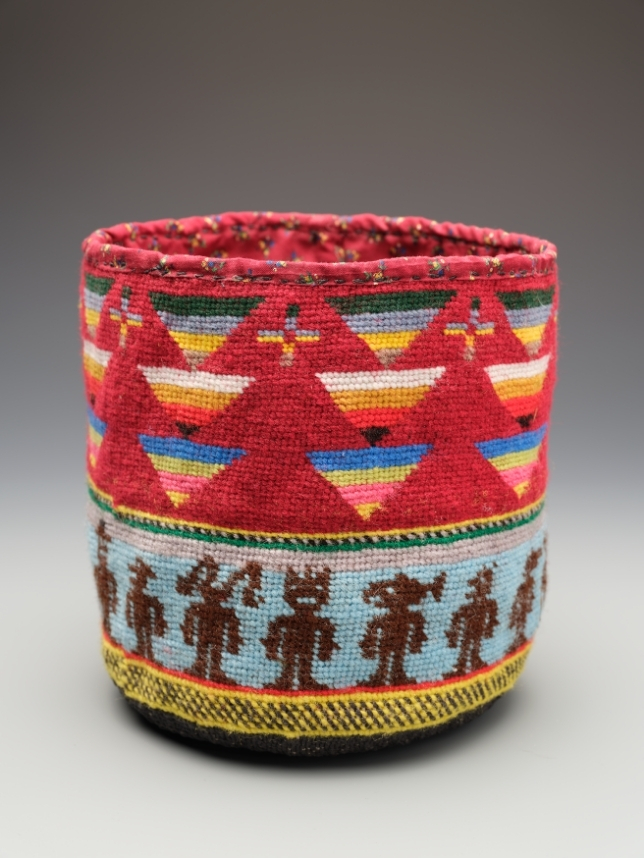
His baskets keep the traditional shapes and techniques, while the imagery comes from the world he actually lives in. One is titled Highway With HOV Lane. Another, Roll Call, lines up figures in rows like a class photo or a winter count. There's an eagle, which he rarely saw as a boy and which returned after DDT was banned. There's a praying mantis that visits his front door, a figure with a television for a head, a high-voltage tower, and a whirlwind he once watched cross the valley while stopped at a Burger King. The basket asks a simple question: who is here now, and who has survived?
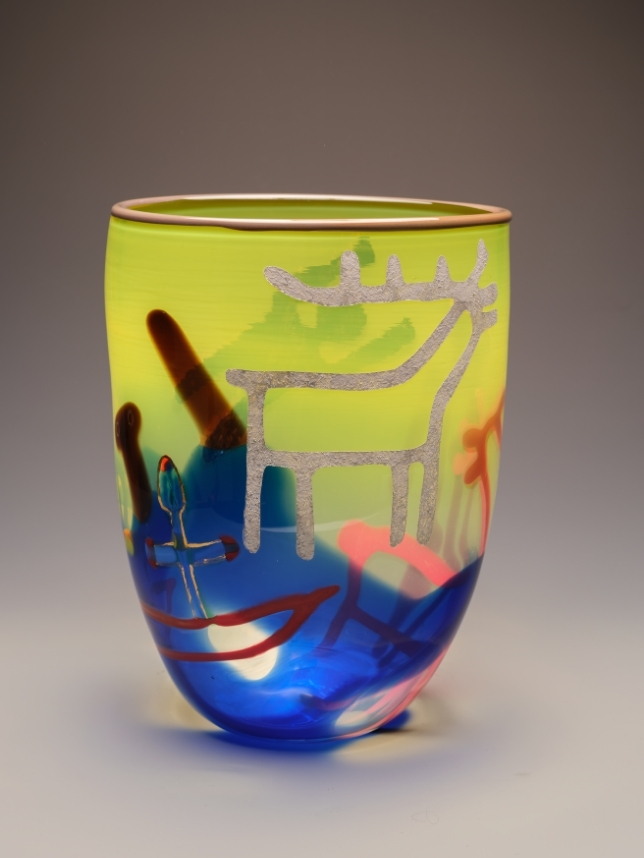
A blown glass vessel that shifts from bright yellow-green at the rim to deep blue at the base, marked with faint white line figures and a brushy red-brown stroke.
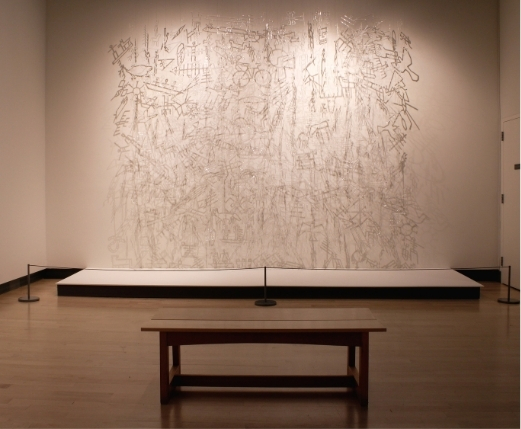
In glass, his blown vessels echo the shapes of his baskets, and his hanging installations of small fused-glass figures, which he calls charms, turn elk, cars, and faces into something close to written language. Across every medium, the same symbols return. He's said he has always thought of himself as a landscape artist, and his landscape simply includes everything that's in it, from petroglyphs to traffic.
When Feddersen retired from full-time teaching in 2009, he could have gone anywhere, and he chose to go back to Omak. As he told Cascade PBS, his Okanagan grandmother had once said to him, "Come home and be with your people." Years earlier, his mother had shared that her own mother longed to have all of them home again.
That longing has shaped the way he works. He's said that, more and more, he wants his projects to bring artists together rather than center on any one person's career. He remembers growing up in Omak without knowing a person could become an artist, and often being the only Native student in the room. He wants young Native artists to know they aren't alone.
Some years ago, he put that belief into practice with a project called Terrain. He invited Plateau Native artists to each carve a small linocut and paired their images with poets from across the Plateau, including Elizabeth Woody and Gloria Bird. The artists ranged from teenagers to elders in their eighties, and they came to Evergreen to print the book together. One person handed paper, one inked, one ran the press. By the end, they'd made roughly 4,000 prints, and the finished sets went to museums. Speaking in his Smithsonian oral history about a later project for Plateau artists, he put the idea plainly: it's "not about exclusion, it's about inclusion."
Art still runs through the family. His nieces, jeweler Carly Feddersen and installation artist RYAN! Feddersen, have built careers of their own, and a nephew went on to study glass. His recent prints honor the thirty buffalo the Kalispel Tribe gave to the Colville Tribes, a homecoming of a different kind.
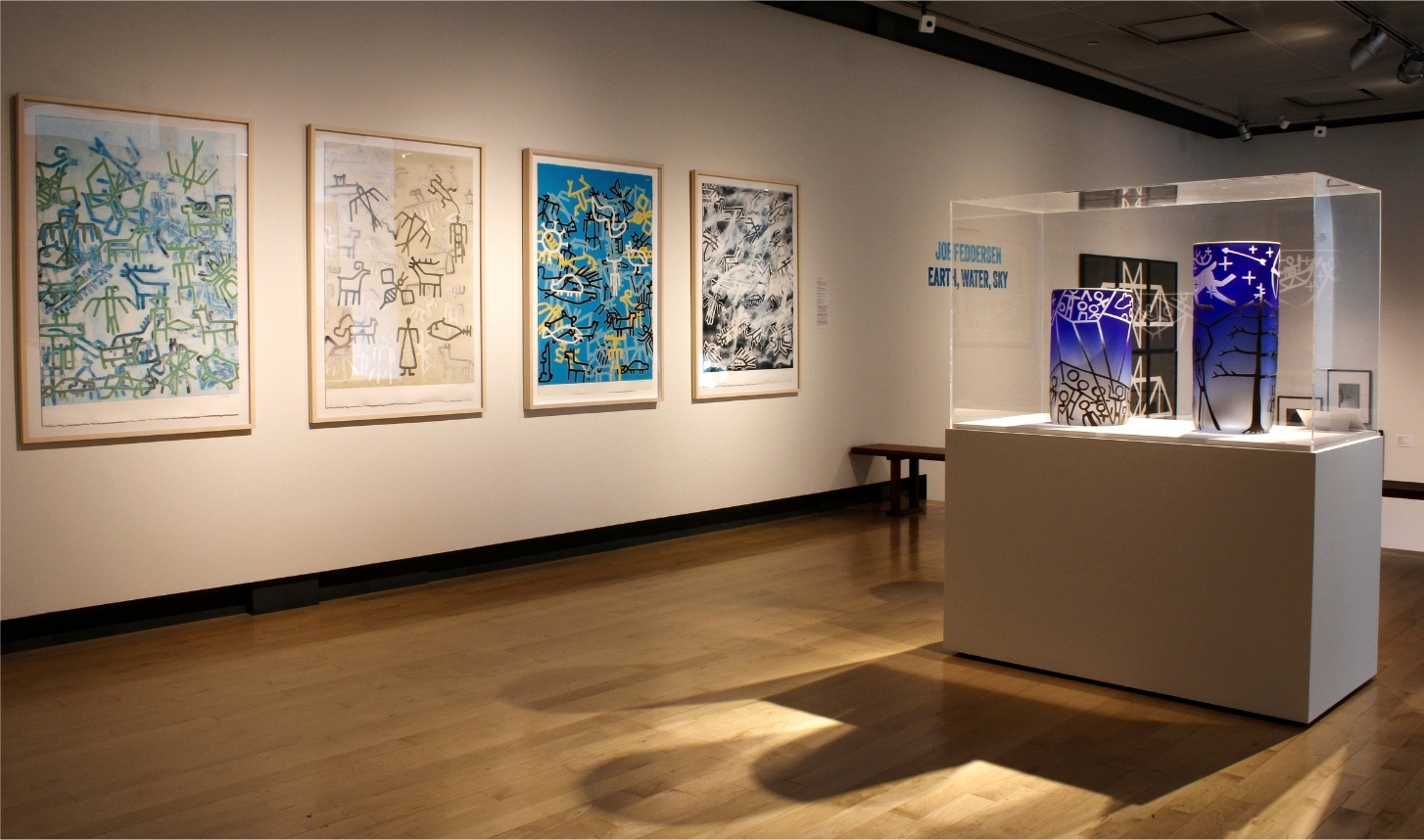
Joe Feddersen: Earth, Water, Sky, the largest exhibition of his career, brings all of it together: more than 120 works spanning prints, glass, basketry, and ceramics, from miniatures to wall-sized installations. The Northwest Museum of Arts and Culture in Spokane organized it, and it premiered there in 2024 before traveling to the High Desert Museum in Bend, Oregon, and then to the Missoula Art Museum.
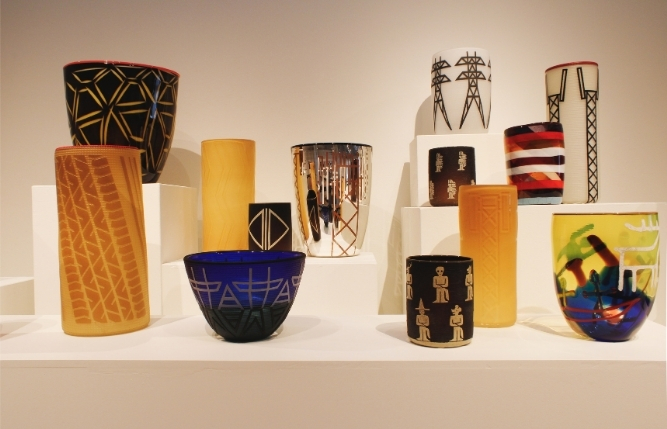
It's fitting that Native creatives shaped the show at nearly every level. It was co-curated by Rachel C. Allen (Nimiipuu) of the Northwest Museum of Arts and Culture and heather ahtone (Choctaw/Chickasaw Nation) of the First Americans Museum in Oklahoma City. Kevin Coochwytewa (Isleta Pueblo/Hopi) designed it, and its videos were produced by Counting Coup Media, a Native-owned company in Spokane. The accompanying catalogue includes poetry by artists he's collaborated with over the years.
For an artist who has spent so much of his life bringing others together, it's a show made the same way he works, in community.
Feddersen's work asks the question Roll Call asks: who is here? His answer includes the elk and the eagle, the praying mantis at the door, the towers on the ridge, and the people who taught him, raised him, and made prints beside him, and nothing in his landscape is left out. Every symbol, old or new, belongs to the same story, and he's still telling it from home.
If you can, go and stand in front of these baskets and glass vessels. Look closely at the patterns, and then read the titles. You may find that a design you took for ancient was drawn from the road you drove in on.
Joe Feddersen: Earth, Water, Sky is on view at the Missoula Art Museum, 335 North Pattee Street, Missoula, Montana, from September 4 to December 31, 2026. Admission is free. The exhibition catalogue, Joe Feddersen: Earth, Water, Sky, is published by the Northwest Museum of Arts and Culture and distributed by University of Washington Press.
Who is Joe Feddersen? Joe Feddersen is an artist born in 1953 in Omak, Washington, of Okanagan and Arrow Lakes descent and a citizen of the Confederated Tribes of the Colville Reservation. He works in printmaking, glass, basketry, and ceramics, and taught at The Evergreen State College for twenty years.
What is Plateau basketry? Plateau basketry is a tradition of the Indigenous peoples of the Columbia Plateau, the region between the Cascade Range and the Rocky Mountains. Feddersen keeps its traditional forms and techniques and brings in imagery from contemporary life.
Where can I see Joe Feddersen's work? His retrospective is at the Missoula Art Museum through December 31, 2026. His work is also held in collections including the Whitney Museum of American Art, the Seattle Art Museum, the Heard Museum, and the Smithsonian's National Museum of the American Indian.
Why do high-voltage towers appear in his art? Feddersen worked for seven years at a hydroelectric dam before becoming an artist. He has described the towers that now cross the ridges near his home as carrying his community's resources away.
Joe Feddersen, Gathering Under the Stars, 2010. Waxed linen, wool, fabric, and thread. Collection of the artist; courtesy studio e gallery, Seattle, Washington. Photograph by Dean Davis. © Joe Feddersen.
Joe Feddersen, Floating By, 2020. Blown glass with enamel. Collection of the artist; courtesy studio e gallery, Seattle, Washington. Photograph by Dean Davis. © Joe Feddersen.
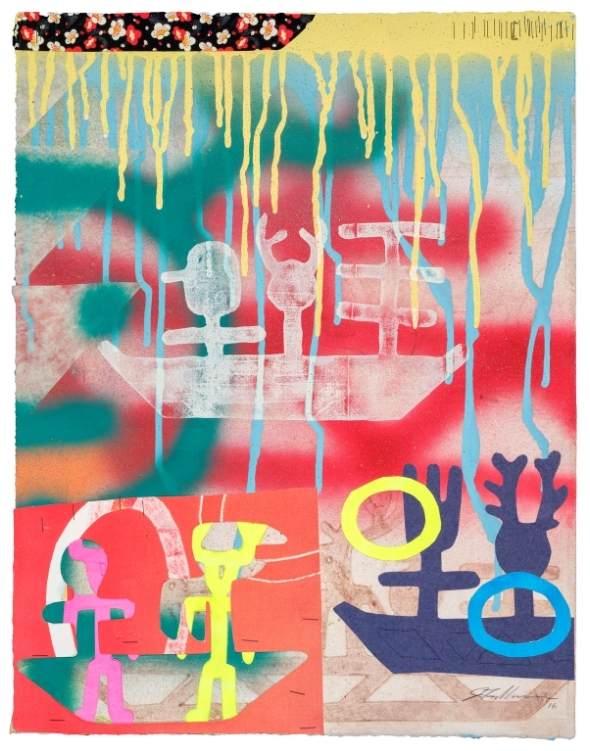
Joe Feddersen, Drizzle, 2016. Relief and stencil monoprint with collage, staples, and spray paint. Collection of the artist; courtesy studio e gallery, Seattle, Washington. Photograph by Dean Davis. © Joe Feddersen.
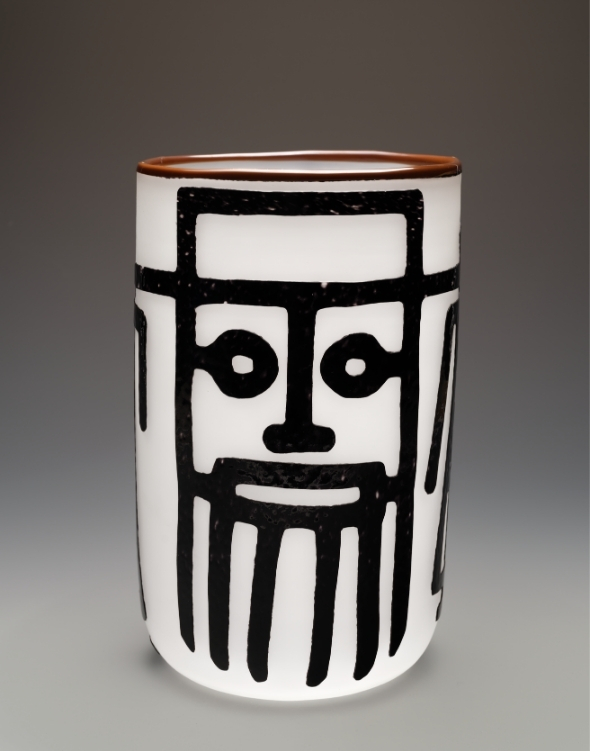
Joe Feddersen, Self Portrait, 2023. Sandblasted blown glass. Collection of the artist; courtesy studio e gallery, Seattle, Washington. Photograph by Dean Davis. © Joe Feddersen.
Installation views of Joe Feddersen: Earth, Water, Sky: credit lines pending from the Missoula Art Museum.