Tribe of Mannequins
6 min read
REROUTE Magazine

.svg)
.avif)




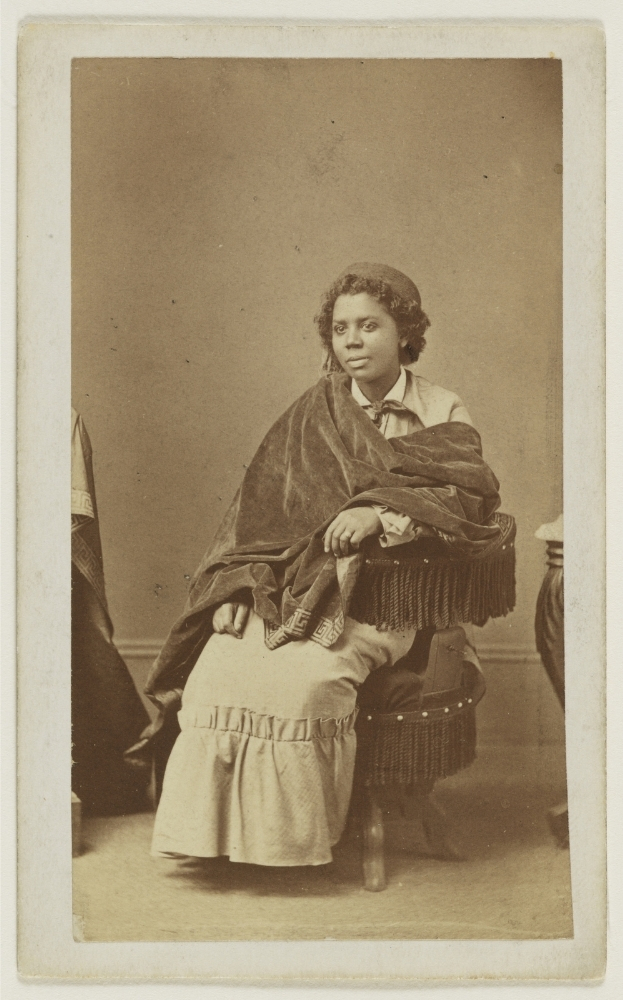
For years, one of the most admired American sculptures of the 1870s stood in the Chicago suburbs, marking the grave of a racehorse. The people who passed it had no idea who made it.
Her name was Edmonia Lewis, and she'd spent her life making sure the world knew her work was hers. She carved her own marble when most sculptors hired workmen. She told her origins in her own words, to anyone who asked. She left her country when it wouldn't make room for her. History lost track of her anyway. Then, slowly, it began to give her name back.
Lewis was the first artist of African American and Native American heritage to earn international recognition. Her life holds triumph, injustice, and a long silence. Running through all of it is a quiet, steady claim: this is mine.
The early life of Edmonia Lewis is hard to pin down, and she seems to have preferred it that way. Reliable records from her early years are scarce, and she gave different accounts of her origins in different interviews. On official documents, she listed 1842, 1844, and 1854 as her birth year.
Historians can say a few things with more confidence. She was born free in upstate New York, in a village then called Greenbush. Her mother had Black and Ojibwe ancestry, and her father was Black and had at one time lived in Haiti. She had an older brother, Samuel, and both children were orphaned while Edmonia was still under ten. She appears to have spent much of her girlhood in Newark, New Jersey.
After her parents died, she lived for a few years with her mother's Ojibwe relatives near Niagara Falls. By her own account, she helped her aunts make baskets and trinkets to sell to tourists. Among her mother's people, she went by the name Wildfire.
Later, she liked to tell interviewers of a wild, free childhood in the forests. Some of those stories were likely shaped for her listeners, since nineteenth-century patrons were fascinated by Native American life. Both things are true at once. Her Ojibwe heritage was real, and she was a gifted author of her own legend.
Her brother Samuel went west during the Gold Rush and prospered. His support paid for her education.
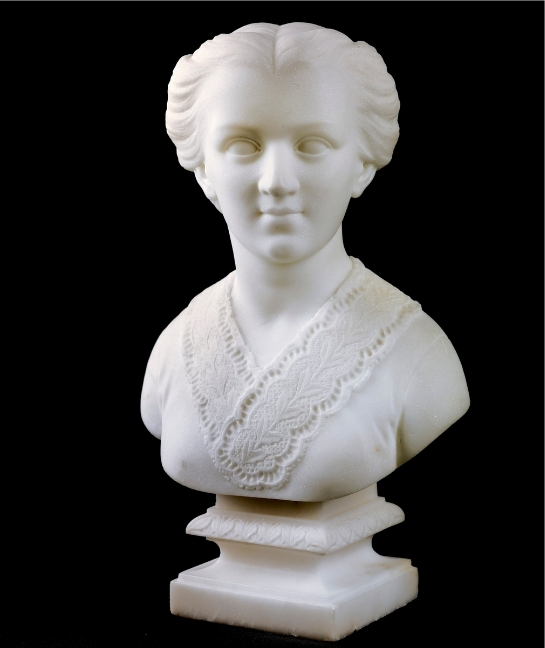
In 1859, Lewis enrolled at Oberlin College in Ohio, one of the few colleges in the country that admitted both women and Black students. She studied drawing and showed real promise.
In January 1862, on a cold, snowy day, she offered to make warm spiced wine for two classmates before a sleigh ride. Both women became violently ill afterward and were certain Lewis had poisoned them. Before the case reached court, a mob of white men seized her, beat her brutally, and left her in a field.
She was defended by John Mercer Langston, an Oberlin graduate who would later serve in Congress. Langston argued that there was no proof any poisoning had occurred, since no one had ever analyzed what the women consumed. The jury acquitted her, and her supporters carried her from the courtroom on their shoulders.
The acquittal didn't end her troubles. She was later accused of theft as well, and in 1863 the college barred her from registering for her final term. She left Oberlin without a degree.
%20REROUTE%20MAGAZINE.jpg)
Lewis arrived in Boston young, determined, and nearly penniless. The city was a center of the abolitionist movement, and its reformers opened doors for her. William Lloyd Garrison gave her letters of introduction, and the sculptor Edward Brackett gave her tools, a few lessons, and encouragement.
She made medallions and portrait busts of abolitionist heroes. Her most important early work honored Colonel Robert Gould Shaw, commander of the 54th Massachusetts Infantry Regiment, one of the first major Black regiments in the Union Army. After the Shaw family bought an original bust, Lewis sold reproductions, and the money funded her passage to Europe.
She later said she'd been "practically driven to Rome," since America offered so little room for a Black sculptor. So she made her own room, across an ocean.
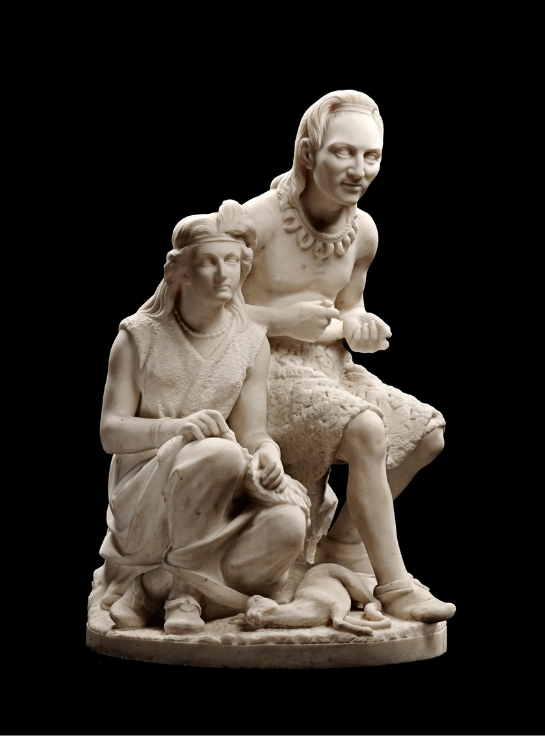
After brief stays in London, Paris, and Florence, Lewis settled in Rome, the center of the neoclassical sculpture world. She joined a circle of American women sculptors working there, and she made a choice that set her apart. Most sculptors of the era modeled their designs in clay and hired Italian workmen to carve the finished marble. Lewis carved much of her own stone, partly so that no one could claim the work wasn't truly hers.
Her Roman years were the most productive of her life. Her subjects reached back to the Bible, to ancient history, and to Longfellow's poem The Song of Hiawatha, whose Ojibwe setting connected to her own heritage. Old Arrow Maker, one of her Hiawatha works, shows a father and daughter in a quiet moment of home life.
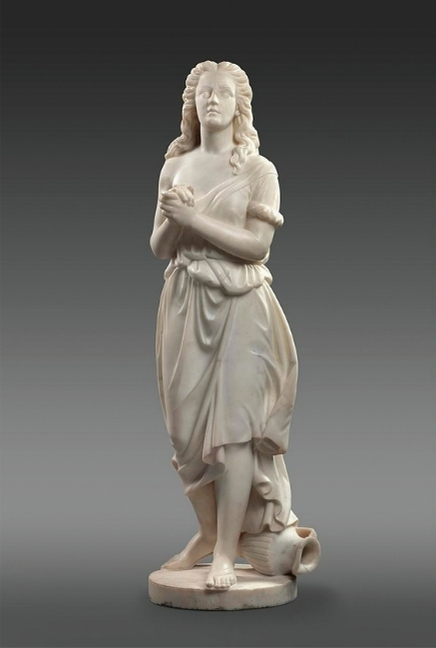
Her most urgent work spoke to her own time. Forever Free, made in 1867, shows a Black man and woman breaking the chains of enslavement. It was likely the first sculpture by a Black artist to celebrate the end of slavery in the United States. It was presented to the Black abolitionist Reverend Leonard Grimes in Boston in 1869, and it's now held by Howard University. Her Hagar, carved in 1875, depicts the biblical servant cast into the wilderness, her face lifted and her hands clasped. Her Moses, carved after Michelangelo that same year, shows her working in direct conversation with the masters.
Her reputation grew. Her work sold for large sums, she won important commissions, and her studio became a fashionable stop for travelers. In 1869, Longfellow himself visited and sat for a portrait bust, which Harvard acquired soon after.
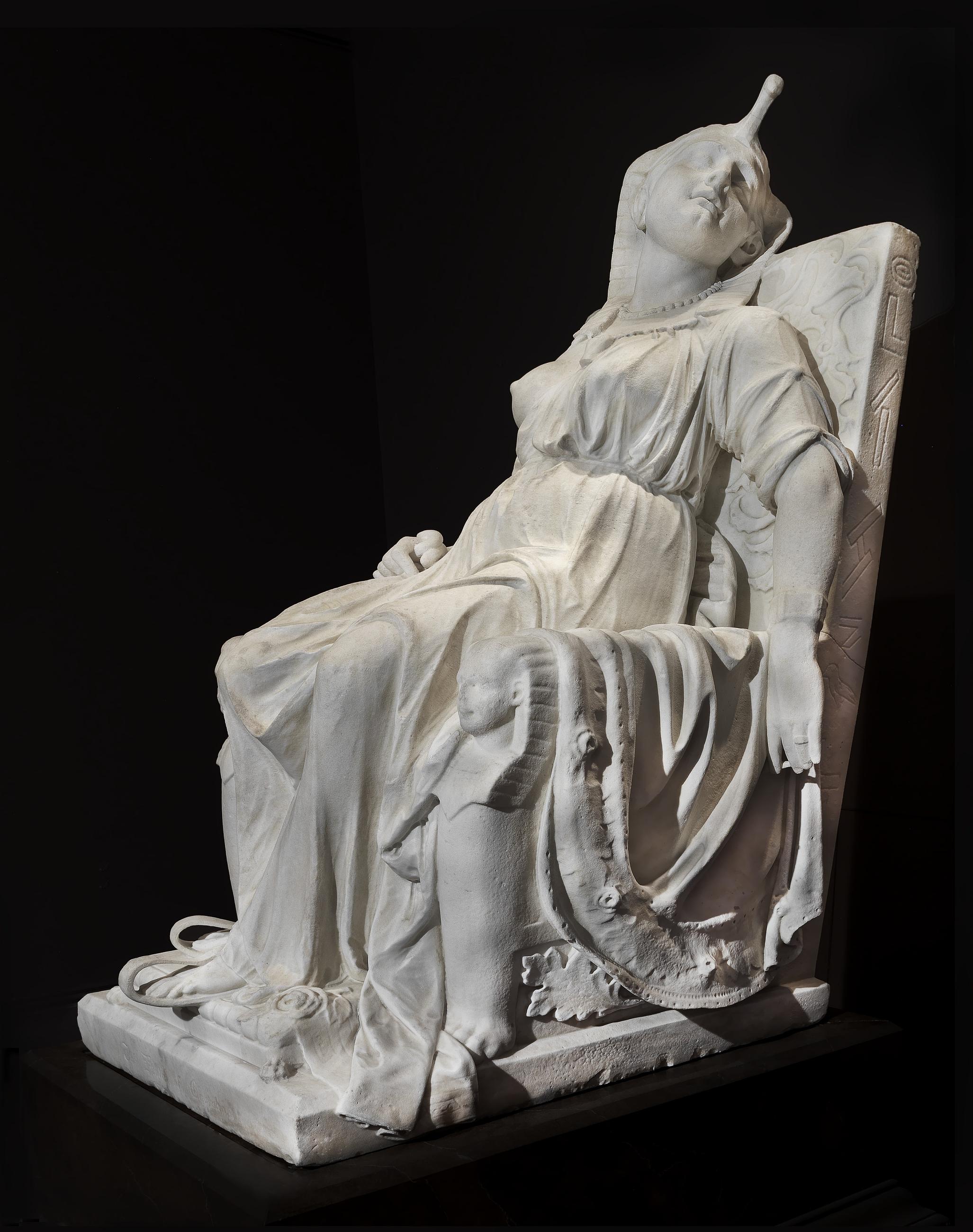
In 1876, Lewis sent her most ambitious work to Philadelphia for the Centennial Exhibition, the grand celebration of America's hundredth birthday. The Death of Cleopatra, a 3,000-pound marble, depicts the Egyptian queen after her death by the bite of an asp.
Earlier sculptors had shown Cleopatra in quiet thought before her death. Lewis showed the moment after, the queen slumped against her throne with unflinching realism. Critics called it the most impressive American sculpture in the exhibition, though some found its directness hard to look at. That boldness is exactly what makes it remarkable today.
Then the sculpture began a strange afterlife. Unsold and too costly to ship home, it passed through several hands. It stood for a time in a Chicago saloon. A gambler bought it and placed it over the grave of his racehorse, named Cleopatra, at a track in Forest Park, Illinois. There it stayed for decades, weathering in the open air, its maker's name unknown to those who passed. Presumed lost for more than a century, it was rediscovered in a salvage yard in the 1980s. It now belongs to the Smithsonian American Art Museum.
.jpg)
Lewis faded from view through several quiet forces working together. Tastes changed. By the 1880s, smooth white neoclassical marble looked old-fashioned to American collectors, who were turning toward new styles from Paris. She'd built her career abroad, far from the American critics and institutions that decide who is remembered. And she left few letters or records behind.
In the 1880s, Lewis withdrew from public life. In 1887, Frederick Douglass visited her in Rome, and she showed him and his wife around the city and Naples. After that, her trail grows faint. She eventually moved to London, where she died on September 17, 1907. For generations, even the date and place of her death were uncertain, until historian Marilyn Richardson confirmed them more than a century later.
Her return began with the rescue of Cleopatra. In 1994, the Smithsonian acquired and restored the sculpture with the help of the Historical Society of Forest Park, and scholars began to piece her story back together.
Much of the recent recognition traces back to one determined advocate. Bobbie Reno, the town historian of East Greenbush, New York, where Lewis was born, had never heard of her before taking the job. Reno had Lewis's London grave restored with a modest slab bearing her name and dates, the simple marker Lewis herself had requested in her will. Reno also championed a U.S. postage stamp in Lewis's honor, issued in 2022 as the 45th stamp in the Black Heritage series. Its portrait, painted by Alex Bostic, is based on a photograph of Lewis taken in Boston by Augustus Marshall.
Then came the most fitting honor of all. Reno asked Oberlin to grant Lewis an honorary degree. In 2022, the college replied that it would award her an actual diploma, in her own name, for the course she'd been kept from finishing. At commencement that June, after 160 years, the last member of Oberlin's Class of 1862 finally graduated.
Looking back on her life in 1878, Edmonia Lewis offered a line that reads like a summary of everything she carried and everything she made:
"Sometimes the times were dark and the outlook was lonesome, but where there is a will, there is a way."
She found her way into marble, into Rome, and into the most celebrated exhibition of her century. When history set her aside, her work endured. Her Cleopatra survived a saloon, a racetrack, and a salvage yard, and it waited, still carrying the marks of the hands that made it.
If you have the chance, go and stand before her sculptures. Notice the hands, the drapery, the tilt of a face. She carved those lines herself, and she wanted the world to know they were hers. Now, at last, it does.
The Smithsonian American Art Museum in Washington, D.C., holds The Death of Cleopatra and several of her other sculptures. Forever Free is in the collection of the Howard University Gallery of Art. The traveling retrospective Edmonia Lewis: Said in Stone is on view at the Georgia Museum of Art in Athens through January 3, 2027, and travels to the North Carolina Museum of Art in Raleigh from April 3 to July 11, 2027.
Smithsonian American Art Museum, Old Arrow Maker
U.S. Postal Service, "U.S. Postal Service Salutes Legendary Sculptor Edmonia Lewis"
Smarthistory, "Edmonia Lewis, Forever Free"
Smithsonian Magazine, "After More Than 150 Years, Sculptor Edmonia Lewis Finally Gets Her Degree"